DETAILS
Database used:
Date:
Category
A recent article by Tom Hacha (Ghent University) and Joeri Aerts (University of Antwerp) discusses the origins, content, and research possibilities of the S.O.S. Antwerp database. The article demonstrates how this unique resource opens new perspectives for studying mortality, health, and social inequality in the past.
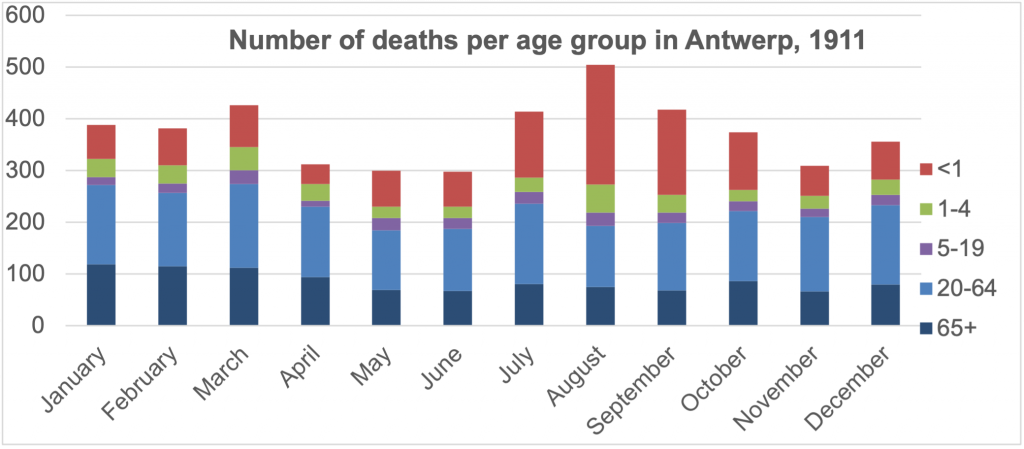
The database contains causes-of-death information for more than 480,000 individuals who died in the city of Antwerp between 1820 and 1946, complemented by extensive biographical and social information. Through links with birth and death certificates, researchers can investigate relationships between social status, gender, age, migration, and health over time.
A major strength of the database is its exceptional temporal depth. The Antwerp cause-of-death register was maintained continuously from 1820 to 1946, making it the oldest and longest-preserved register of its kind in Belgium. This enables researchers to study the transition from a society plagued by infectious diseases such as cholera and smallpox to one in which chronic conditions became increasingly important.
The article also emphasizes the database’s broad applicability. Today, S.O.S. Antwerp is used in research on social and spatial mortality inequalities, epidemics, and the historical origins of health disparities. In addition, it serves as a valuable resource for genealogical research and international comparisons with similar projects elsewhere in Europe.
S.O.S. Antwerp is an initiative of the Quetelet Center at Ghent University, developed in collaboration with the Centre for Urban History at the University of Antwerp, Histories vzw, and the FelixArchief. The digitization of the sources was made possible through the efforts of hundreds of citizen scientists.
Publication:
Tom Hacha & Joeri Aerts, “S.O.S. Antwerpen: het Antwerpse doodsoorzakenregister als bron voor onderzoek naar historische sterfteverschillen (1820–1946)”, Contemporanea, 52(2026), 2.