Sampling selection technique brings order to the chaos

DETAILS

Used database

BETHUNE

Date:

October 2017

Category:

Scientific publication

SAMPLING SELECTION TECHNIQUE BRINGS ORDER TO THE CHAOS

In the BETHUNE database, you can find the sales invoices of the textile company Bethune & Fils. The database was created as part of the doctorate of Annik Adriaenssens: “Van laken tot linnen. De textielhandel Bethune & Fils. Tweede helft achttiende eeuw. Een analyse op basis van het bedrijfsarchief” (“From cloth to linen. The textile trade of Bethune & Sons. Second half of the eighteenth century. An analysis based on the company archive”). For their research, Coessens and Heirman got to work on the sales invoices created between 1737 and 1799, which were included in the database.

Read the full chapter (in Dutch):
Coessens, Ine, and Wim Heirman, “Statistische steekproefmethodes: Een handleiding tot statistisch verantwoorde selectie”. In Handboek Archiefbeheer in de praktijk (“Statistical sampling methods: A guide to statistically sound selection”. In Handbook for Archive Management in practice). Vol. 102. 2017.

Researchers draw on LOKSTAT for a study of building permit policy in Flanders

DETAILS

Used database:

LOKSTAT

Date:

November 2017

Category:

Publication

RESEARCHERS DRAW ON LOKSTAT FOR A STUDY OF BUILDING PERMIT POLICY IN FLANDERS

The memorandum “Building permit policy in Flanders”, which is part of a four-part report commissioned by the Flemish government, presents an analysis of the building permit database for the whole of Flanders for the period 1962-2016. The database contains more than 3.5 million building permit applications. The LOKSTAT data were used to estimate population growth, which has a direct effect on the number of building permit applications. The LOKSTAT dataset on municipal population sizes is a unique historical source which enables a diverse range of quantitative analyses.

Memorandum:

Vanoutrive, Thomas, and Jeroen Cant. Vergunningenbeleid in Vlaanderen: kwantitatieve analyse van de vergunningendatabank (Building permit policy in Flanders: quantitative analysis of the building permit database). Brussels: Flemish Planning Bureau for the Environment and Spatial Development, 2017.


Who took care of the poor?

DETAILS

Used database:

STREAM

Date:

November 2018

Category:

Publicatie

WHO TOOK CARE OF THE POOR?

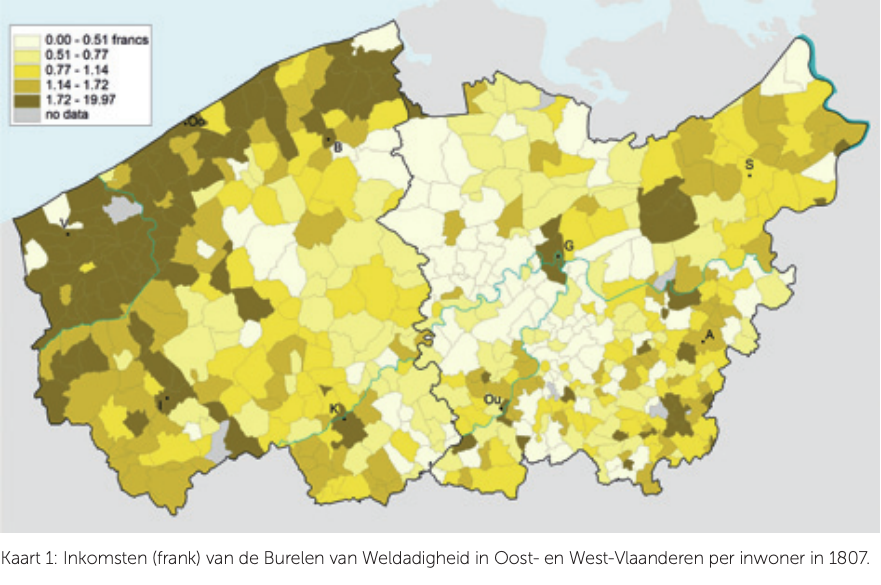
In the latest issue of the journal “Continuity and Change”, Nick Van Den Broeck, Anne Winter (Vrije Universiteit Brussel) and Thijs Lambrecht (Ghent University) investigate regional differences in poor relief on the early modern Flemish countryside. Based on data from the STREAM database, they demonstrate that the way in which relief was organized was directly related to regional socio-economic structures (such as farm size, property structures and organization of the labour market).

Article:

Van den Broeck, Nick, Thijs Lambrecht, and Anne Winter. “Pre-Industrial Welfare between Regional Economies and Local Regimes: Rural Poor Relief in Flanders around 1800.” Continuity and Change 33, no. 2 (2018): 255–84.

Abstract:

“This study uses data on income and distribution of relief payments from local poor relief tables for 512 rural parishes in Flanders (present-day Belgium) in 1807 to examine spatial variation in poor relief  practices in a region characterised by well-established local poor relief institutions and marked socio-economic differences. By combining data on poor relief with local data on population, landholding and occupational structure, we map out the relative importance of regional economies and local variation in producing distinct poor relief regimes. The results show that although local variation was considerable, the nature and extent of this variation interacted with structural socio-economic characteristics to produce regional patterns, signaling that local variation did not so much contradict as constitute regional patterns in poor relief regimes. The importance of socio-economic characteristics in determining both regional patterns and local variation supports our more general contention that local and regional levels of analysis represent a more fruitful avenue for understanding variations in poor relief practices than national differences in legislation, and therefore has implications for the comparative study of poor relief practices in a wider international context.”

500 years of housing rents

DETAILS

Used database:

POPPKAD

Date:

April 2019

Category:

Research report

500 YEARS OF HOUSING RENTS

Thies Lindenthal (University of Cambridge, Department of Land Economy), Matthijs Korevaar and Piet Eichholtz (both from Maastricht University, School of Business and Economics) took a close look at the rental prices of urban housing and set out their findings in a paper for the Real Estate Research Centre in Cambridge. They studied the development of prices in seven major cities (Amsterdam, Antwerp, Bruges, Brussels, Ghent, London and Paris) between 1500 and 2017. For their research, they had access to a collection of unique historical data, including cadastral data and more than 6000 rental contracts from the POPPKAD database.

Apart from temporary fluctuations due to local circumstances, the relationship between housing rents to wages has been more or less constant for centuries. Rental prices clearly rose from 1900 onwards. The increase was more a result of the improvement in the quality of housing than an increase in the rent itself.

Research report:

Lindenthal, Thies, Matthijs Korevaar and Piet Eichholtz. “500 Years of Urban Rents, Housing Quality and Affordability”. University of Cambridge, Department of Land Economy, Working Paper Series, 2019-1, 1–71.

Geographical differences in causes of death

DETAILS

Used database:

HISSTER

Date:

May 2018

Category:

Scientific publication

GEOGRAPHICAL DIFFERENCES IN CAUSES OF DEATH

For their article “Spatial disparities at death. Age-, sex- and disease-specific mortality in the districts of Belgium at the beginning of the twentieth century”, Tina Van Rossem, Patrick Deboosere and Isabelle Devos used the HISSTER database. They reconstructed the age-, sex- and disease-specific mortality rates for the 41 districts of Belgian for the year 1910. Based on the data collected in the HISSTER database, they created maps that reveal the regional variations in mortality rates. 

Read the full article here.

Consult the HISSTER database to start working with the data yourself:

Article:

Van Rossem, Tina, Patrick Deboosere, and Isabelle Devos. “Spatial disparities at death. Age-, sex- and disease-specific mortality in the districts of Belgium at the beginning of the twentieth century”. Espace Populations Sociétés (Space Populations Societies), no. 1–2 (2018): 1–22. 

Old, older, oldest

DETAILS

Used database:

STREAM

Date:

October 2017

Category:

Scientific publication

OLD, OLDER, OLDEST

Isabelle Devos and Tina Van Rossem used the STREAM infrastructure to gain an insight into regional variations in health. STREAM contains data on baptisms and burials in Flanders for hundreds of early modern parishes. In addition, the research infrastructure makes it possible to visualise the data on a map by using a geographic information system. Devos and Van Rossem showed that although the mortality crises in early modern Flanders were caused by epidemics and military conflicts, the structural regional differences can mainly be explained by the topography.

Read the full article here.

Article:

Devos, Isabelle, and Tina Van Rossem. “Oud, ouder, oudst: regionale en lokale verschillen in sterfte in het graafschap Vlaanderen tijdens de zeventiende en achttiende eeuw”. De Zeventiende Eeuw (“Old, older, oldest: regional and local differences in mortality in the county of Flanders in the seventeenth and eighteenth centuries”. The Seventeenth Century), 2017, 39–53. 

Take a look at the STREAM page:

The many faces of poor relief

DETAILS

Used database:

STREAM

Date:

January 2018

Category:

Publication

THE MANY FACES OF POUR RELIEF

In their article in “Tijd-Schrift: Heemkunde en Lokaal-erfgoedpraktijk” in Vlaanderen, Lambrecht and Winter show how poor relief in rural areas in the county of Flanders was organised during the 18th century. Based on data from the STREAM database, they were able to deduce that almost all municipalities in the former county had revenues for poor relief. The municipalities obtained these revenues from, among other things, rental income from real estate, interest from capital and taxes. Admittedly, there was considerable spatial variation in the sums spent on poor relief. The data on poor relief revenues have been transformed into a map by staff at the Quetelet Center (see figure).

Article:

Lambrecht, Thijs, and Anne Winter. “De vele gezichten van zorg: armoede en armenzorg op het platteland in het graafschap Vlaanderen tijdens de achttiende eeuw” (“The many faces of care: poverty and poor relief in rural areas in the county of Flanders during the eighteenth century”). Tijd-Schrift: Heemkunde en Lokaal-erfgoedpraktijk in Vlaanderen (Tijd-Schrift: Local History and Local Heritage Practice in Flanders) 7, no. 1 (2017): 44–57.

A piece of land for everyone?

DETAILS

Used database

LOKSTAT and POPPKAD

Date:

2017

Category:

Conference paper

A PIECE OF LAND FOR EVERYONE?

Article:

Ronsijn, Wouter. “‘Gaining ground’ in Flanders after the 1840s: access to land and coping mechanisms of (semi-)landless households in Flanders, ca. 1850-1900”, Rural History Conference, 1–35. Leuven, 2017

Abstract: 

“This paper explores whether, as a result of this shifting power balance, rural households in Flanders in the second half of the nineteenth century were literally gaining ground. All scholars see this period as a profound turning point for the Flemish countryside, affecting both rural coping mechanisms and agricultural production methods. […] Up until then, livelihoods in Flanders often combined small-scale farming for one’s own account with wage labour or market-oriented production, although there were regional variations to that pattern. This paper focuses on what happened with access to land, the indispensable condition for the first component. Did access to land increase, as would be consistent with the change of fortunes mentioned above, or did it decrease, as would be consistent with the overall, long-term European trend of rising landlessness? […] The paper reconstructs the extent of landlessness (households without land) and semi-landlessness (households with less than 2 ha of land, the minimum required for subsistence; this includes households without land) in Flanders, and to indicate the factors affecting that extent in the second half of the nineteenth century. It asks how many landless and semi-landless households there were in Flanders, and how access to land fit in with their other activities? The paper focuses on developments in four regions showing divergent patterns: the districts of Veurne, Kortrijk, Sint-Niklaas and Oudenaarde.” 

Was Grandpa a Nazi?

DETAILS

Used database:

LOKSTAT

Date:

2017

Category:

Book

WAS GRANDPA A NAZI?

Book:

Aerts, Koen, Dirk Luyten, Bart Willems, Paul Drossens, and Pieter Lagrou. Was opa een nazi? Speuren naar het oorlogsverleden van je familie (Was Grandpa a Nazi? Researching the war history of your family). Tielt: Lannoo N.V., 2017.

Brief summary

Around half a million Belgians – in Flanders, Brussels and Wallonia – have a family member who was ‘wrong’ during the Second World War. Grandpa, grandma, father, mother, uncle or aunt. Initially there were more than 400,000 files on suspects. Around 100,000 citizens actually received sentences, ranging from execution to imprisonment or loss of rights. Today, grandchildren and other family members are increasingly searching for the facts behind the events to come to terms with this past. In Was opa a Nazi?, war historians and archivists provide the tools for people to investigate for themselves this often unspoken about aspect of the war.

How your lifestyle as a teenager has more implications than you might think …

DETAILS

Used database:

LOKSTAT

Date:

2017

Category:

Scientific publication

HOW YOUR LIFESTYLE AS A TEENAGER HAS MORE IMPLICATIONS THAN YOU MIGHT THINK...

Article: 

Depauw, Ewout, and Deborah Oxley. “Toddlers, teenagers and terminal heights: the determinants of adult male stature, Flanders, 1800-76”. Edited by Rui Esteves en Gabriel Geisler Mesevage. Discussion Papers in Economic and Social History 157 (2017): 1–34.

Abstract: 

“Does adult stature capture conditions at birth or at some other stage in the growth cycle? Anthropometrics is lauded as a method for capturing net nutritional status over all the growing years. However, it is frequently assumed that conditions at birth were most influential. Was this true for historical populations? This paper examines the heights of Belgian men born between 1800-76 to tease apart which moments of growth were most sensitive to disruption and reflected in final heights. It exploits two proximate crises in 1846-49 and 1853-56 as shocks that permit age effects to be revealed. These are affirmed through a study of food prices and death rates. Both approaches suggest a shift of the critical moment away from the first few years of life and towards the adolescent growth spurt as the most influential on terminal stature. Furthermore, just as height is accumulated over the growing years, conditions influencing growth need to be understood cumulatively. Economic conditions at the time of birth were not explanatory, but their collective effects from ages 11 to 18 years were strongly influential. Then, both health and nutrition mattered, in shifting degrees. Teenagers, not toddlers, should be our guides to the past.”

The Quetelet Center provides base maps of Belgium for the World War I Linked Open dataset

DETAILS

Used database:

LOKSTAT

Date:

November 2017

Category:

Scientific publication

THE QUETELET CENTER PROVIDES BASE MAPS OF BELGIUM FOR THE WORLD WAR I LINKED OPEN DATASET

Article: 

Mäkelä, Eetu, Juha Törnroos, Thea Lindquist, and Eero Hyvönen. “WW1LOD: an application of CIDOC-CRM to World War 1 linked data”. International Journal on Digital Libraries 18, no. 4 (November 2017): 333–43.


Abstract: 

“The CIDOC-CRM standard indicates that common events, actors, places and timeframes are important in linking together cultural material, and provides a framework for describing them. However, merely describing entities in this way in two datasets does not yet interlink them. To do that, the identities of instances still need to be either reconciled, or be based on a shared vocabulary. The WW1LOD dataset presented in this paper was created to facilitate both of these approaches for collections dealing with the First World War. For this purpose, the dataset includes events, places, agents, times, keywords, and themes related to the war, based on over ten different authoritative data sources from providers such as the Imperial War Museum. The content is harmonized into RDF, and published as a Linked Open Data service. While generally based on CIDOC-CRM, some modeling choices used also deviate from it where our experience dictated such. In the article, these deviations are discussed in the hope that they may serve as examples where CIDOC-CRM itself may warrant further examination. As a demonstration of use, the dataset and online service have been used to create a contextual reader application that is able to link together and pull in information related to WW1 from, e.g., 1914–1918 Online, Wikipedia, WW1 Discovery, Europeana and the Digital Public Library of America.”

LOKSTAT in the service of medieval research

DETAILS

Used database:

LOKSTAT

Date:

December 2017

Category:

Scientific publication

LOKSTAT IN THE SERVICE OF MEDIEVAL RESEARCH

Book: 

De Keyzer, Maïka. Inclusive commons and the sustainability of peasant communities in the medieval Low Countries. New York (N.Y.): Routledge, 2017. 

Abstract: 

“Is inclusiveness in the commons and sustainability a paradox? Late medieval and Early Modern rural societies encountered challenges because of growing population pressure, urbanisation and commercialisation. While some regions went along this path and commercialised and intensified production, others sailed a different course, maintaining communal property and managing resources via common pool resource institutions. To prevent overexploitation and free riding, it was generally believed that strong formalised institutions, strict access regimes and restricted use rights were essential.

By looking at the late medieval Campine area, a sandy, infertile and fragile region, dominated by communal property and located at the core of the densely populated and commercialised Low Countries, it has become clear that sustainability, economic success and inclusiveness can be compatible. Because of a balanced distribution of power between smallholders and elites, strong property claims, a predominance of long-term agricultural strategies and the vitality of informal institutions and conflict resolution mechanisms, the Campine peasant communities were able to avert ecological distress while maintaining a positive economic climate.”

Click here to work with the LOKSTAT-databank:

In search of a new quantitative method

DETAILS

Used database:

LOKSTAT

Date:

October 2017

Category:

Publication

IN SEARCH OF A NEW QUANTITATIVE METHOD

Abstract:

“Economic historians that study long-term changes during the nineteenth and twentieth century are fundamentally restricted by the availability of qualitative data. As a result, researchers are forced to either impute missing data, or otherwise combine datasets in some way. In this article, we demonstrate the versatility of state-space models in addressing these problems. Not only do they enable us to compose large data series of high quality, they also provide a clear estimate of how reliable this data is, allowing any subsequent analyses to take this reliability into account. We illustrate the advantages of a state-space model using the population of Belgian municipalities as a case study. By combining growth and level data, we are able to compute yearly population statistics of over 2600 municipalities from 1880 to 1970.”


Article: 

Ronsse, Stijn, en Samuel Standaert. “Combining growth and level data: an estimation of the population of Belgian municipalities between 1880 and 1970”. Historical Methods: A Journal of Quantitative and Interdisciplinary History 50, no. 4 (2017): 218–26. 

A history of famine

DETAILS

Used database:

LOKSTAT

Date:

September 2017

Category:

Scientific publication

A HISTORY OF FAMINE

In “Famine in European History, an international overview” published by Cambridge University Press, historians Daniel Curtis, Jessica Dijkman, Thijs Lambrecht and Eric Vanhaute use population statistics from the LOKSTAT database for their analysis of living standards in the Low Countries.

The book provides an overview of famine in Europe through the centuries. Each chapter has been written by national experts on the history of famine. The chapter on the Low Countries takes a close look at the specific causes of famine in these regions. From the late 16th century onwards, the Northern Netherlands largely escaped famine thanks to Amsterdam’s central position in the European grain trade. In contrast, famine occurred more frequently in the Southern Netherlands, where it was mainly caused by war.”

Book:

Curtis, Daniel, Jessica Dijkman, Thijs Lambrecht, and Eric Vanhaute. “Low Countries”. In Famine in European History, edited by Guido Alfani and Cormac Ó Gráda, 119–40. Cambridge University Press, 2017. 

Welcome to the Quetelet Center website!

DETAILS

Used databases:

LOKSTAT, POPPKAD, STREAM

Date:

August 2017

Category:

Weblaunch

WELCOME TO THE QUETELET CENTER WEBSITE!

bewerkt
We are proud to present our website and the first large-scale quantitative historical databases managed by the Quetelet Center!

LOKSTAT

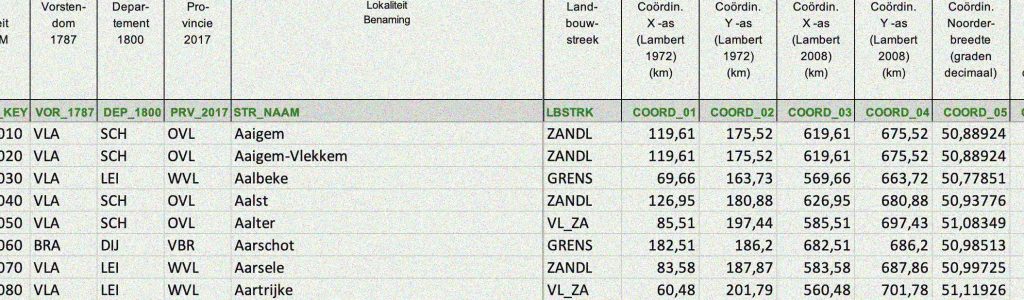
LOKSTAT is a database of local and regional statistics in Belgium from the period 1800-1970. The data collections are based on official censuses of the population, agriculture, trade and industry. Data series from other historical sources, such as election results, also appear in the database. Using the cartographic module HISGIS, the data can be presented on a map and analysed in detail.

POPPKAD

POPPKAD brings together data on property and opens up this information about land ownership for scientific research. The data infrastructure is based on the land registry, which has kept an inventory of real estate in Belgium since 1834. The database contains statistics on land use, land ownership and housing at national level (1834-1961). It also includes property data per owner for different regions and places.

STREAM

The STREAM database contains an extensive and diverse collection of local statistics from the early modern period (ca. 1500-1815). The data series included are linked to a customised geographic information system that enables comparative research in time and space by linking different datasets to each other and to localities. The Ferraris map (1770-1777) constitutes the primary source. This map was manually vectorised and then compared with current topographical maps to eliminate geometric discrepancies. As a result, one can view a reconstruction of the landscape, housing, boundaries and transport infrastructure as a series of snapshots over time of the area in question.


Follow the news page on our website to keep up to date with the latest publications based on these databases, new datasets and all our other activities!

GIS databases available for research

DETAILS

Used database:

GIS - databases

Date:

2018

Category:

Databases & tools

GIS DATABASES AVAILABLE FOR RESEARCH

Over the course of the 19th century, P.C. Popp published the cadastral plans and registers of 1 733 municipalities in Belgium. The maps show a detailed representation of buildings, plots, roads, waterways and other landscape elements. Used in combination with the property descriptions, this unique publication constitutes an important source for historical geography, industrial archaeology, social history, local history, toponymy and other research areas.

 The cadastre of Bruges, Brussels, Ostend, Langdorp, Mazenzele and Ramskapelle as published by Popp was fully digitised and converted into a Geographic Information System as part of the POPPKAD project. The associated databases contain basic identification data on buildings, plots and landowners in these towns and municipalities.

Why were farmers taller than weavers?

DETAILS

Used database:

LOKSTAT

Date:

December 2017

Category:

Scientific publication

WHY WERE FARMERS TALLER THAN WEAVERS?

Ewout Depauw used municipal population figures and other data from the LOKSTAT database for his research into living standards in rural Flanders during the 19th century. Thanks to the cartographic module HISGIS, which is part of the research infrastructure, it was also possible to perform a spatial analysis of the data. Discover the results of Depauw’s research in the article “Tall Farmers and Tiny Weavers. Rural Living Standards and Heights in Flanders, 1830-1870”. Discover the results of Depauw’s research in the article. 

Article

Depauw, Ewout. “Tall Farmers and Tiny Weavers. Rural Living Standards and Heights in Flanders, 1830-1870”, TSEG/ Low Countries Journal of Social and Economic History 14, no. 3 (2018): 56–84. 

Abstract: 

“The evolution of the average stature of convicts between 1830 and 1870 in the prisons of Ghent and Bruges is used as a measure of the biological standard of living and suggests progress in the quality of life in the Flemish countryside, particularly for children born after 1850. Heights are used to shed light on regional variations. Prisoners born in coastal Flanders were on average shorter than inmates born in inland Flanders. Heights furthermore provide a key to discovering specific socio-economic differences that can explain such variations, showing that wage labourers in coastal Flanders and textile workers in inland Flanders were the shortest occupational groups, especially before 1850. As such, heights provide a nuanced picture of living standards in rural Flanders during the nineteenth century.”

Grand plans, the cadastral atlas of Belgium

DETAILS

Used database

POPPKAD

Date:

January 2018

Category:

Publication

GRAND PLANS, THE CADASTRAL ALTALS OF BELGIUM

The atlas by P.C. Popp is a commercialised version of the cadastre which brings together different information about property from large parts of the country. It consists of more than 41 000 pages and over 2 300 maps, where buildings, plots and owners are described separately. The publication is one of a kind. There are no publications that can match Popp’s work in terms of scale, wealth of information and level of detail.

Today researchers are grateful for the opportunity to use this unique reference work. If you are looking for solid information about people, buildings, landscapes, housing, agriculture, industry, spatial planning or local history in 19th-century Belgium, then this is the publication for you.

Although the atlas has long enjoyed fame among historians and geographers, the publication is still largely shrouded in mystery. What motivated the creators is a matter of conjecture. Nor is it known why there are no similar reference works in Belgium and its neighbouring countries.

In addition to the history of the publication’s origins, Grootse Plannen also contains a detailed description of the atlas itself. All 1 735 of the issues published are described individually in the book and (often for the first time) dated. Moreover, Grootse Plannen gives a methodological explanation of house research with the help of Popp’s atlas.

The POPPKAD database, which is managed by the Quetelet Center, also opens up access to the extensive reference work of P.C. Popp.

Would you like to start working with this data yourself? Then be sure to consult the POPPKAD page.

Sven Vrielinck
Amsterdam University Press
Hardback,
164 pages,
ISBN 978 94 6298 785 2
Price: 29,99 €

Order:

Adolphe Quetelet, a bridge builder

DETAILS

Used database:

/

Date:

February 2018

Category:

Adolphe Quetelet

ADOLPHE QUETELET, A BRIDGE BUILDER

As the founder of statistics, Adolphe Quetelet (1796-1874) played a pioneering role in the evolution of government institutions and scientific research in 19th-century Belgium. Schamper journalist Selin Bakistanli interviewed Isabelle Devos, a history professor in the Department of History at Ghent University and coordinator of the Quetelet Center, about how important this man was in the development of statistical data collection and interpretation.

Read the full article here (in Dutch).

What was wrong with West Flemish people?

DETAILS

Used database:

LOKSTAT, HISSTER

Date:

March 13th, 2018

Category:

Publication

WHAT WAS WRONG WITH WEST FLEMISH PEOPLE?

In the article “Grasduinen in de bevolkingsgeschiedenis: wat was er mis met de West-Vlamingen?” (“Browsing through population history: what was wrong with West Flemish people?”), Kristof Clerix discusses the Mouvement, a huge source of information on the 19th-century population of Belgium, which has become accessible in part through the LOKSTAT and HISSTER databases of the Quetelet Center. The Mouvement de la Population et de l’Etat Civil, or Mouvement for short, consists of an extensive series of registers full of tables with masses of statistics on the Belgian population in the period 1841-1976. The registers contain detailed figures on births, marriages, deaths, causes of death, etc. up to the level of municipalities.

Kristof Clerix talks to Isabelle Devos, Quetelet coordinator, who arrived at some remarkable insights thanks to the partial integration of the data from the Mouvement into the LOKSTAT and HISSTER databases. By linking the information from the Mouvement to the historical Geographic Information System developed by staff at the Quetelet Center and displaying this on a map, it became possible to uncover regional differences and put forward new hypotheses for interpreting, for example, mortality rates.

Would you also like to find out more about why there were so many deaths in the Westhoek? Then be sure to read the full article in Knack by Kristof Clerix or look up the scientific publications on this subject by Isabelle Devos.

Consult the LOKSTAT or HISSTER database page to start working with the data yourself.