From S.O.S. Antwerp to War Diaries

DETAILS

Used database:

S.O.S. ANTWERP

Date:

September 2025

Category:

Citizen Science Project

The Quetelet Center has developed extensive expertise in creating scientific databases through citizen science and crowdsourcing. A notable example of this is the S.O.S. Antwerp project, which created a comprehensive and accessible database in collaboration with volunteers.

The knowledge developed in this project is now also being used to support other initiatives. For example, Archiefpunt recently called on the Quetelet Center’s expertise in the context of the War Diaries project.

The War Diaries project focuses on collecting, digitising, and making accessible personal documents such as diaries and letters from the war years. These personal sources offer valuable insights into daily life during conflicts and are an indispensable addition to traditional archives. Crowdsourcing and volunteers are also used to make the large amount of material accessible.

In this case, no database was transferred, but methodological expertise and practical guidelines were shared with regard to organising large-scale data entry by volunteers and the sustainable management of such databases.

In this way, the Quetelet Center contributes not only through the development of research databases but also by sharing knowledge and expertise that strengthens other projects.
The Hidden History of Medical Instrument Makers

DETAILS

Used database:

LOKSTAT

Date:

May 2025

Category:

Research Project

The project Manufacturers of medical instruments, equipment and accessories in Flanders and Brussels by ETWIE and the Industriemuseum systematically mapped, for the first time, which companies were active in the production of medical-technological devices in the period 1830–1960. 

Until now, collections had mainly focused on the functioning of the devices, while the stories of the manufacturers themselves often remained unknown. With this broad study, ETWIE and the Industriemuseum filled that gap. They charted who the manufacturers were, what products they developed, and how their activities fitted into broader technological and economic evolutions. 

To achieve this, they combined archives, literature and museum collections, supplemented with case studies of notable players. The research looked not only at the technical aspects, but also at production chains, export, and international embedding. This resulted in a unique inventory that provides more insight into the role of Flanders and Brussels within medical technology. 

These findings are valuable for heritage preservation and for writing the industrial history of the healthcare sector. The researchers relied on the LOKSTAT database, which allowed them to access company data in a clear and detailed way. Thanks to the 1896 industrial census available through LOKSTAT, manufacturers and producers could be fully mapped.


Discover the project here.


From Fields to Asphalt: AI Reveals the Urbanisation of Flanders

From Fields to Asphalt: AI Reveils the Urbanisation of Flanders

DETAILS

Used database:

LOKSTAT

Date:

July 2025

Category:

Research Project

Between 1778 and 2022, the Flemish landscape underwent profound transformations. This is shown by a recent study by the Research Institute for Nature and Forest (INBO) under the direction of Luc De Keersmaeker, in which historical land use was analyzed with the help of artificial intelligence. Using the software OrthoSeg, three major map series were processed: the Ferraris map (1778), the Dépôt de la Guerre map (1873), and the MGI map (1969), each compared with the current land-use map of 2022.

The results speak for themselves. Heathland and dunes, which covered 12% of Flanders in the 18th century, shrank to less than 1%. Forests remained relatively stable at around 10%, but shifted significantly in location. Arable land declined from 60% to 30%, while grasslands more than doubled due to the so-called Agricultural Invasion. Built-up areas and gardens increased dramatically: from 2% in 1778 to 20% today. More than half of the coastal dunes disappeared because of urbanization and infrastructure.

Remarkably, only 20% of Flanders maintained the same land use over 250 years. Thanks to the historical LOKSTAT database, with municipal boundaries from 1850, the maps could be georeferenced with precision. This enabled reliable comparisons and provided unique insights into the evolution of the Flemish landscape.

The full report and interactive maps are available via INBO.

Launch of the S.O.S. Antwerp Database

Launch of the S.O.S. Antwerp Database

DETAILS

Used database:

S.O.S. Antwerpen

Date:

April 2025

Category:

Citizen Science project

On April 22, 2025, the festive launch of the S.O.S. Antwerp database took place at the FelixArchief. This unique database provides access to data on more than 480,000 deaths in the city of Antwerp between 1820 and 1946. It represents an exceptional resource, enabling historians, genealogists, and interested citizens to explore the health history of the city from a new perspective.

During the event, Werner Pottier and Sarah Heynssens offered an insight into the origins of the project. Special tribute was paid to the 761 volunteers who helped transcribe thousands of cause-of-death registers. Their efforts, led by the Quetelet Center and in collaboration with the FelixArchief, the Universities of Antwerp, and Histories vzw, made this database possible.

The program continued with three inspiring research lectures. Professor Isabelle Devos highlighted the epidemiological transition through the course of various diseases. Professor Hilde Greefs demonstrated how the data can be mapped and which new patterns become visible. PhD student Tom Hacha presented his research into the exceptionally high child mortality in historical Antwerp. Together, these contributions illustrated how the database provides valuable insights into causes of death, health crises, and social inequalities.

The launch concluded with a warm reception, where volunteers and partners celebrated together. It was not only a moment of gratitude, but also of pride in what had been achieved collectively.

The S.O.S. Antwerp database is now freely accessible and offers a rich source of information for researchers as well as anyone interested in the history of health, disease, and society.

What Death Tells Us

Why do people in some places die earlier than in others? Despite improvements in healthcare, regional differences in mortality remain significant—and in some cases, have even grown. The newly released issue of Space-Populations-Societies, entirely devoted to the study of causes of death, illustrates how diseases spread over time and across regions, from tuberculosis in industrial cities to Covid-19 in densely populated urban neighborhoods. Our living environment, social situation, habits, and the quality of care all play a crucial role.

This special issue brings together 15 contributions that present the results of recent research on major causes of death, both past and present. The studies focus on diseases such as cholera, tuberculosis, influenza, Covid-19, cardiovascular diseases, cancer, and dementia. The issue was produced in collaboration with the Quetelet Center, with several of its researchers presenting findings from the INEQKILL project.

Publication:
“La mortalité selon les causes de décès: approaches spatio-temporelles”, Space-Populations-Societies, issue 2023/3 – 2024 /1.
https://journals.openedition.org/eps/14303


DETAILS

Database used: HISSTER and LOKSTAT

Date: November 2024

Category: Scientific publication

Land Management and Large Estates

Sander Berghmans recently obtained his PhD in History and Applied Economic Sciences at Ghent University. In his dissertation, he investigates how large landowners in the Southern Netherlands managed their estates between 1600 and 1820, and how their decisions influenced both the economy and society.
Through various case studies, he demonstrates how these landowners, such as the Dukes of Arenberg and the abbots of Roosewalle and Ename, maximized their profits through strict management, financial strategies, and by excluding smaller farmers.
Their choices significantly impacted the local population and broader economic developments. Berghmans applies economic theories, such as principal-agent theory, to better understand these practices and advocates for greater attention to historical context in economic research.
Researchers at the Quetelet Center contributed to the project by producing maps that illustrate, among other things, the distribution of large landholdings.

Publication:

Sander Berghmans. Dukes and Abbots: Essays on the Economics of Estate Management in the Southern Netherlands (ca. 1600-1820). Ghent, PhD Dissertation, 2025.


DETAILS

Database used: STREAM & LOKSTAT

Date: March 2025

Category: Scientific publication

New International Election Data Available

For comparative research on democracies worldwide, scholars use international datasets such as Democratic Electoral Systems (DES) database. This widely used database contains data on legislative and presidential elections in democracies since 1945. Nils-Christian Bormann (Universität Witten/Herdecke) and Leo Kaftan (Leibniz Institute for the Social Sciences, Cologne) have now expanded the data collection to include elections held between 1919 and 1945 in 34 countries, including Belgium.

These data provide insights into the effects of different electoral systems on party fragmentation and the stability of democracies. The historical data are also useful for understanding relevant issues in contemporary democracies, such as the impact of institutional choices and the evolution of electoral rules. They can be linked to other scientific sources and offer a valuable basis for comparative analyses.

During the processing of the Belgian data, Bormann and Kaftan relied on LOKSTAT to map election results. The DES database is accessible, among other platforms, via the Dataverse of Harvard University.

Article:

Nils-Christian Bormann, Lea Kaftan. “Introducing the Democratic Electoral Systems data, 1919-1945”, in: Open Research Europe, 4(2024), 1-18.


DETAILS

Database used: LOKSTAT

Date: February 2025

Category: Scientific publication

Soil and Power

During the Middle Ages and early modern period, numerous lordships existed across the Low Countries. A lordship was a territory where a local lord held various privileges—administrative, judicial, and economic. Biologist Margreet Brandsma and historian Jim Van der Meulen (UGent) studied the spatial distribution of lordships and their relationship with geophysical factors such as soil fertility, relief, and proximity to waterways. By comparing Gelre and Hainaut, they demonstrated that lordships primarily emerged in economically attractive areas with fertile soils and favorable trade routes. In Gelre, waterways played a crucial role in the concentration of elite power structures, whereas in Hainaut, relief was a determining factor. Using historical maps and GIS analysis, the study introduces an innovative methodological approach to visualizing and quantifying power structures in premodern landscapes. The results confirm that natural environmental factors significantly influenced the spatial organization of feudal power relations in the medieval Low Countries. To achieve these insights, the authors also utilized soil data from the LOKSTAT database.

Article:

Margreet Brandsma, Jim Van der Meulen. “The Lordscape: Seigneurial Jurisdictions in the Late-Medieval Low Countries”, in Journal of Historical Geography, 86(2024), 1, 355-371.


DETAILS

Database used: LOKSTAT

Date: January 2025

Category: Scientific publication


Flax Retting Pits in the Landscape

For centuries, the Land of Dendermonde and the Land of Waas were inextricably linked to flax cultivation and processing. The region enjoyed an excellent reputation in the textile sector, thanks in part to a unique retting method used to extract fibers from the flax plant. This process took place in small, stagnant water bodies, the so-called flax retting pits, which were scattered across the landscape.

Lies Vervaet, a collaborator of the Regional Landscape Schelde-Durme and former researcher at Ghent University, sheds new light on this nearly forgotten heritage. Through interviews with the last witnesses and an in-depth study of historical maps and archival sources – including agricultural censuses from LOKSTAT – she brings the significance of these retting pits back into focus. Not only did they play a crucial role in the regional economy, but they also offer opportunities today for biodiversity, water management, and heritage preservation.

Publication:

Lies Vervaet, Stille waters: vlasrootputten in het Land van Dendermonde en het Land van Waas. Die Keure, 2024, 200 p.


DETAILS

Database used: LOKSTAT

Date: December 2024

Category: Scientific Publication

Brussels under construction

The construction sector played a crucial role in the economic development of Brussels but remained underexplored. Matthijs Degraeve (VUB) mapped the long-term changes in the sector using a database of 16,700 construction enterprises and cadastral data from POPPKAD and LOKSTAT. His research shows how the sector experienced industrialization and market concentration on one hand, yet remained dominated by small-scale, flexible businesses on the other. As the city grew, the number of contractors increased, while specialized craftsmen declined. Economic crises led to temporary market concentration, whereas periods of growth encouraged fragmentation. Technological advancements boosted productivity in certain subsectors, but most businesses remained sole proprietorships or family firms. Ultimately, the sector slowly evolved towards larger and more capital-intensive enterprises.

Article:

Matthijs Degraeve. “The Business of City Building: Long-Term Change and Continuity in the Construction Sector (Brussels 1830-1970)”, Enterprise & Society, 2024, 1-32.

https://www.cambridge.org/core/journals/enterprise-and-society/article/business-of-citybuilding-longterm-change-and-continuity-in-the-construction-sector-brussels-18301970/4D3B50580CB8AB532C89CC527C33DC80


DETAILS

Database used: POPPKAD and LOKSTAT

Date: October 2024

Category: Scientific publication


How Trains Shaped Belgium

Ingrid Schepers (UA) recently defended her doctoral dissertation on the impact of railways on labor mobility in Belgium. Her research reveals how the 19th-century, government-led railway infrastructure shaped the relationship between urban and rural areas. Belgium was a pioneer in developing a public railway network and promoting commuting by train. The government sought to ease urban overcrowding by improving connections between rural and urban regions. Affordable railway subscriptions made commuting a viable alternative to migration, but data from 1846-1961 shows that railway accessibility did not automatically lead to increased commuting. Besides transport, labor markets and economic structures played a crucial role. The study emphasizes that commuting policies should first be seen as an economic necessity before being considered a matter of spatial preferences. These findings are based on detailed analyses of railway infrastructure and commuting flows, made possible through extensive census data available via LOKSTAT.

Article:

Ingrid Schepers. “Mobilising labour: a spatial analysis of railway infrastructure, commuting flows and rural-urban relations in Belgium, 1846-1961”. Antwerp, PhD Dissertation, 2024, pp. 1-361.


DETAILS

Database used: LOKSTAT

Date: July 2024

Category: Scientific publication

Ghent’s Lands

Today, Ghent owns approximately 1,800 hectares of rural land, mainly outside the city limits. However, this once totaled 5,000 hectares of fields, meadows, and forests.

The story of Ghent’s agricultural land begins in the 13th century when wealthy city dwellers, abbeys, and hospitals acquired land beyond the city walls. For centuries, hospitals relied on these lands to maintain financial stability and provide food for the city’s poor and sick. In the 20th century, the city expanded with the port and highways, the newly reformed Public Social Welfare Centre (OCMW) changed its social policies and stopped distributing food, and the agricultural sector underwent significant transformation. As a result, some of Ghent’s agricultural lands were sold and fell into oblivion.

The Ghent’s Lands exhibition changes that by shedding light on this intriguing chapter in Ghent’s history, as well as that of other cities, through illustrations, film footage, and remarkable objects. The exhibition also features an impressive overview map of all municipal lands, created with the help of POPPKAD.

Exhibition:

Ghent’s Lands, from March 22 to September 29, 2024, at the Ghent City Museum (STAM).


DETAILS

Database used: POPPKAD

Date: April 2024

Category: Exhibition

Regional Policy Under the Microscope

Every country has regions whose economic development and level of prosperity lag behind compared to other areas. While Flanders became increasingly economically successful from the 1960s onwards, Wallonia fell behind. Even within Flanders, however, regional economic disparities persisted until the late 1990s. Although the call for government intervention arose as early as before the Second World War, it wasn’t until the 1950s that a more structured policy emerged, offering financial and fiscal support to specific regions. This policy aimed to create equal opportunities for all regions and unlock their economic potential.
In a PhD dissertation recently submitted at Ghent University, historian Ophelia Ongena shows that this process was far from straightforward, and was heavily influenced by political circumstances and linguistic-community tensions. From the 1970s onwards, Flanders gained increasing authority over economic policy, which led to new strategies and growing involvement of companies themselves in addressing regional unemployment.
For this research, the 1937 industrial census from LOKSTAT was used as source.

Publication:

Ophelia Ongena. “Werk in eigen streek!” Ontstaan en evolutie van een economisch beleid op maat van streken en regio’s (België, tweede helft van de 20ste eeuw). Ghent, PhD Dissertation, 2024.


DETAILS

Database used: LOKSTAT

Date: February 2024

Category: Scientific publication

From textiles to tobacco: Flemish industry in 1738.

DETAILS

Used Dataset:

STREAM

Date:

December 2023

Category:

Publication

From textiles to tobacco: Flemish industry in 1738

How was industry faring in Flanders in the first half of the 18th century? Wouter Ryckbosch and Anne Winter (VUB) investigated industrial production and labor in nineteen Flemish towns in 1738. Using the industrial survey from that year, the results of which are available in STREAM, they examined the extent and nature of urban industries, the role of craft guilds, and local labor relations.

Their analysis confirms the dominance of textile production and guild crafts in the examined towns. The research also reveals the presence of industries focused on consumption, such as the manufacturing of glass, tobacco, and soap. While these industries were numerically marginal at the time, they would experience significant growth in the second half of the century. The study also indicates that these sectors were less organized on a craft guild basis and had a higher degree of proletarianization.

Article:

Ryckbosch, Wouter and Winter, Anne. “Between corporatism and capitalism? Urban industry and labor in eighteenth-century Flanders”, TSEG – The Low Countries Journal of Social and Economic History, 20 (2023): 37-80.

Interdisciplinary research with COST-Action ‘The Great Leap’

DETAILS

Used Dataset:

HISSTER, S.O.S. Antwerp

Date:

June 2023

Category:

Interdisciplinary collaboration

INTERDISCIPLINARY RESEARCH WITH COST ACTION 'THE GREAT LEAP'

Isabelle Devos from the Quetelet Center is the co-supervisor of the COST Action ‘The great leap. Multidisciplinary approaches to health inequalities, 1800-2022 (GREATLEAP)’.

COST Action is an interdisciplinary research network that brings researchers and innovators together to investigate a topic of their choice for 4 years. COST Actions are typically comprised of researchers from academia, SMEs, public institutions, and other relevant organizations or interested parties.

Embracing the COST Mission, the Great Leap takes a unique, multidisciplinary approach from a historical perspective to understand better the roots and drivers of health inequalities across regions and countries in Europe and beyond. To achieve this mission, the Great Leap creates an international, multidisciplinary network that will bundle expertise, techniques, insights, and data to create

(1) the first international comparable dataset of individual-level historical cause of death data,

(2) innovative analytical tools to analyze it, and

(3) insights into how this information can be used in current public health policy and practice.

The network includes a wide range of academic expertise in history, social sciences, life sciences, and epidemiology and involves university-, research-, government- and (international) health institutes and organizations, including statistical offices and national archives. 

By fostering the strengths of this unique, multidisciplinary, and diverse network, the Great Leap aims to generate ground-breaking insights into the historical roots and drivers of health inequalities across regions and countries in Europe and beyond.

Interested parties can apply here to participate in one or more of the five working groups of the Cost-Action. 

An award for S.O.S. Antwerpen

DETAILS

Used dataset:

S.O.S. ANTWERP

Date:

14 November 2023

Category:

Database

S.O.S. ANTWERPEN RECEIVES PRESTIGIOUS DISTINCTION

Isabelle Devos, Sarah Heynssens and Sven Vrielinck were awarded an Annual Prize for Science Communication by the Royal Flemish Academy of Belgium (Koninklijke Academie van België) and the Young Academy (Jonge Academie) for the project S.O.S. Antwerp

In the citizen science project on demography and death in Antwerp, citizens not only participated in data collection and analysis, they were also encouraged to engage in historical research themselves. The jury awarded S.O.S. Antwerp the distinction because, thanks to training, assignments and exchanges with team members, citizens gained real insight into the process of science . 

You can learn more about the database that resulted from this project here:

POPPKAD surpasses 10,000 users

DETAILS

Used dataset:

POPPKAD

Date:

September 2023

Category:

Database

POPPKAD surpasses 10,000 users

POPPKAD, the database of the Belgian land registry from the nineteenth century, is gaining popularity among a wide audience. Researchers, local historians, genealogists, and other enthusiasts are increasingly exploring the database, which contains the names of 540,000 property owners from the mid-19th century in over 1,000 Belgian municipalities. According to the latest statistics, 10,000 users have extensively utilized the website. The top 5 most searched terms include (not surprisingly) the names Janssens, Peeters, Willems, Maes, and De Smet. On the project website, you can not only discover the most common surnames but also access scans of the original land registry records. These records provide detailed information about property owners, buildings, and lands from the nineteenth century. Preliminary figures indicate that over 25,000 records have been downloaded from the site after consulting the database. 

Explore the rich past via POPPKAD!

Land and credit as driving forces

DETAILS

Used dataset:

LOKSTAT, POPPKAD

Date:

October 2023

Category:

Doctoral research

LAND AND CREDIT AS DRIVING FORCES

Recently, Nicolas De Vijlder earned his doctorate in History and Business Economics at Ghent University. His dissertation delves into the structural significance of capital in the development of the Southern Low Countries between 1400 and 1900.

Emphasizing the role of land and credit as dominant productive factors, the author explores how the exchange of these forms of capital profoundly influenced society. Market transactions of land and credit were examined in both urban and rural settings, utilizing detailed case studies and macro-analyses. The research highlights the commercialization of the countryside, the growing interconnection between city and rural areas, and the long-term effects of market activities on socio-economic relationships. This study also demonstrates the feasibility and relevance of applying quantitative and econometric research methods to historical issues.

Nicolas De Vijlder based his research in part on datasets from LOKSTAT and POPPKAD, including outcomes from trade and industry censuses.

Publication:

Nicolas De Vijlder, Essays on Land and Credit Markets: The Southern Low Countries 1500-1900. Ghent, PhD Dissertation, 2023.


The demise of keuter farms in Coastal Flanders

DETAILS

Used dataset:

STREAM

Date:

January 2023

Category:

Scientific publication

The demise of keuter farms in Coastal Flanders

Farms were under tremendous pressure during wars. In addition to the destruction and the diseases spread by the roaming bands of armies, the governments or occupiers also increased the tax burden. This burden was so high that some farms went bankrupt. 

In Coastal Flanders, the wars went hand in hand with farm expansion in the 17th and 18th centuries, with large (tenant) farmers gobbling up the downtrodden small- and medium-sized farms. This indicates that large (tenant) farmers were better able to withstand the heavy pressure of rising taxes. 

Combining accounting data from farms and tax collector accounts, Sander Berghmans (UGent, Dep. History) shows that taxes played a crucial role in the enlargement of farms in Coastal Flanders. First, his research showed that taxes were a very important expense for farms, especially during wars. Second, he was able to proof that large farms were able to secure payment deferrals. 

Although granting payment deferrals was not allowed by local governments, it was found that local tax collectors did so for large farms. Large farms possessed the social and economic power to obtain payment deferrals from the tax collector. Smaller and medium-sized farms did not have this power and were therefore declared bankrupt very rapidly in the event of arrears. Their abandoned farms could then be leased for little money by the large farms. Territorial data from the STREAM-database were used for the spatial representation of data in this study.

Deadly heat

Deadly heat

DETAILS

Used dataset

S.O.S. Antwerpen

Date:

November 2022

Category:

Blog post

Author: Wouter Ronsijn

The summer of 2022 was hot and dry, with a heat wave from 9 to 16 August. Once again, the heat wave resulted in additional deaths. Was this also the case in the past? 

We compared data from the database of S.O.S. Antwerp with temperature data collected by Belgium’s main weather station in Uccle for the period 1833-1946 and established that although the mortality during heat waves was also higher in the past, heat waves only occurred sporadically. 

The summer of 1911 was exceptionally hot and led to about 200 additional deaths in Antwerp alone. These were mainly young children, who died with symptoms of stomach flu.


Health risk of extreme heat

We have had another hot, dry summer. A heat wave swept across the country from 9 to 16 August. For many people, the extreme heat poses a major health risk. The elderly and people with cardiovascular or respiratory problems in particular run a greater risk of death. During the heat wave, 343 more people died in Belgium than we would normally expect at this time of year. That is a lot, but far fewer than during the heat wave of August 2020, the first corona year, when there were no fewer than 1,460 more deaths than expected.

Did heat in the past also cause more deaths? We got to work with the provisional figures for the daily number of deaths in Antwerp, collected by the volunteers of S.O.S. Antwerp. The database of S.O.S. Antwerp contains individual data on everyone who died in the city between 1820 and 1946, including gender, age, marital status and also the cause of death of the deceased. The database allows one to determine the number of deaths per day. By comparing these figures with the daily temperatures recorded in Uccle from 1833 to 1946, we can investigate the link between heat waves and deaths.

Mortality during historical heat waves

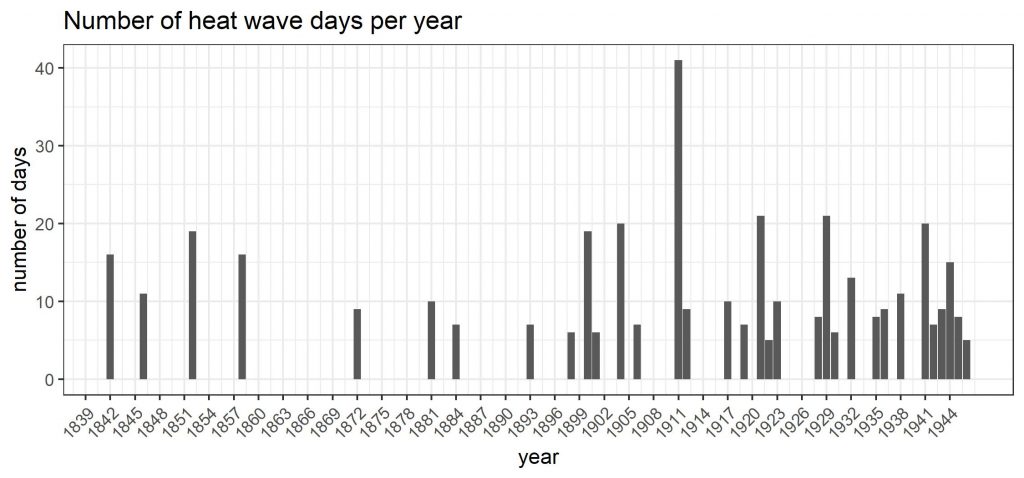
For each day, we calculated the expected mortality based on the average over the same period in the five previous and five subsequent years. We then compared the expected mortality with the actual mortality. If the actual mortality is higher than the expected mortality, we speak of ‘excess mortality’. To determine the impact of heat, we looked at excess mortality on days that were part of a heat wave. Heat wave days are the days in a period of at least five consecutive days reaching 25 °C or more, with at least three of these days attaining 30 °C or more (graph 1.).

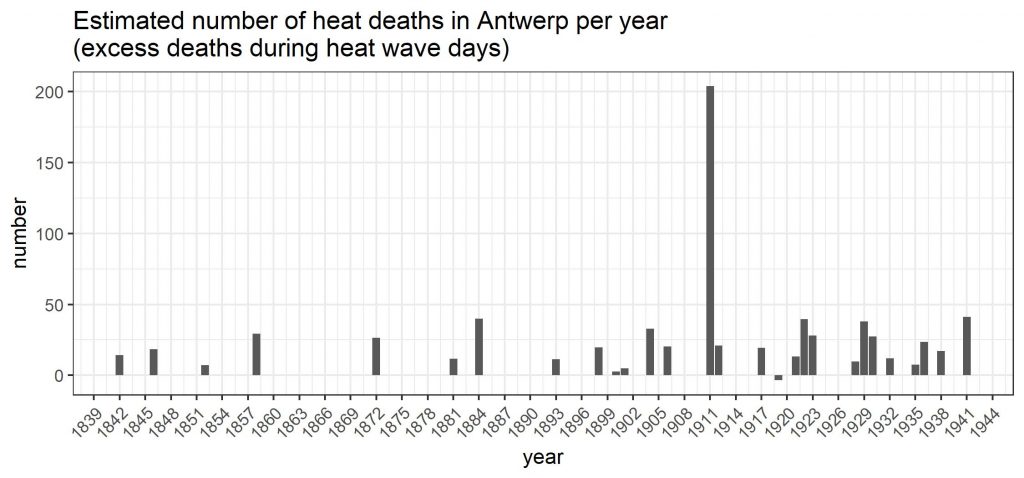
We established that heat waves in the past did indeed lead to excess deaths. On heat wave days from June to September, the daily mortality in Antwerp between 1833 and 1946 was no less than 15 to 20 per cent higher than expected. However, the impact of heat waves differed greatly from year to year. Some heat waves resulted in few additional deaths, others in many more (graph 2.).

Much depended on the intensity of the heat (how hot it got during the day as well as how much it cooled off at night) and the duration of the heat wave. If we look at an estimate of the number of heat deaths during heat waves per year, we see that the impact was usually relatively limited. As graph 2 shows, the number of heat deaths in Antwerp was rarely more than 20 or 30 per year in the years with a heat wave. There is one notable exception: the year 1911, with no fewer than 204 heat deaths (44 per cent more deaths on heat wave days). We also see that heat waves occurred more frequently in the twentieth century than in the nineteenth century (graph 1.)

Graph 1.
Graph 2.

These results are provisional, as the method used can be further refined. We only looked at deaths on heat wave days (i.e. days that formed part of a series of warm days), and so did not take into account deaths on individual days with high temperatures. In addition, we only looked at deaths on those days themselves, while heat could also have had an effect on the number of deaths one or two days later, when it was cooler again. 

Finally, we worked with the original, uncorrected temperature observations from the Belgian Royal Meteorological Office. The temperature was measured in open cabinets until 1983, and only afterwards in closed cabinets. Adjusting the temperature observations to correspond with observations in closed cabinets would mean adjusting the summer temperatures downwards. As a result, we would find fewer heat waves than we do now with the uncorrected data.

The deadly summer of 1911

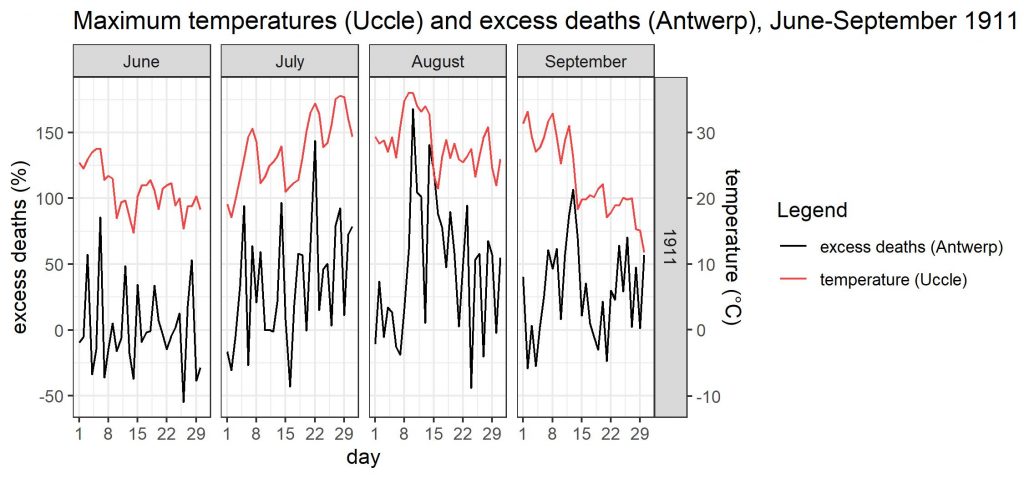
So the year 1911 had an exceptionally deadly summer. What was happening then? It was unusually hot that year. From 1 July to 30 September, a maximum temperature of 25 °C or more was recorded in Uccle on 59 days, with maximum temperatures above 30 °C noted for 24 of those days! (graph 3.)

During those months, the Antwerp newspapers Het Handelsblad and Gazet van Antwerpen regularly reported on the problems the heat was causing, in Antwerp and beyond. At the end of July, there were still upbeat stories about the heat leading to a general exodus to the sea. But soon there were also reports about Antwerp residents who, hit by sunstroke, were taken to hospital. 

The police officers on horseback in particular appeared to have had a hard time. One can read in the Gazet van Antwerpen of 11 August that their horses wore straw hats for protection against the sun, but that they themselves succumbed under their heavy helmets. Not only would these “lethal lids” make the officers lose their hair in the heat, but also threaten their health.

Graph 3.

Many of the reports sadly sound familiar. The drought that accompanied the heat led to forest fires, such as in Marche-les-Dames, or reduced crops to ashes, while a factory in Wetteren had to close temporarily due to lack of water. 

Elsewhere, several factories in the country halted work for part of the day as workers became ill from the heat. In Antwerp, the heat and drought caused several fires, including a very large fire in the warehouses of the Compagnie des Magasins Généraux et Entrepots libres d’Anvers. 

In Brussels, people were kept awake not only by the heat but also by an infestation of fleas. Looking for ways to cool down, many slept in the open air, in the Bois de la Cambre, the park of Koekelberg or the Warande of Sint-Gillis. According to Het Handelsblad, at night these places turned into vast camps.

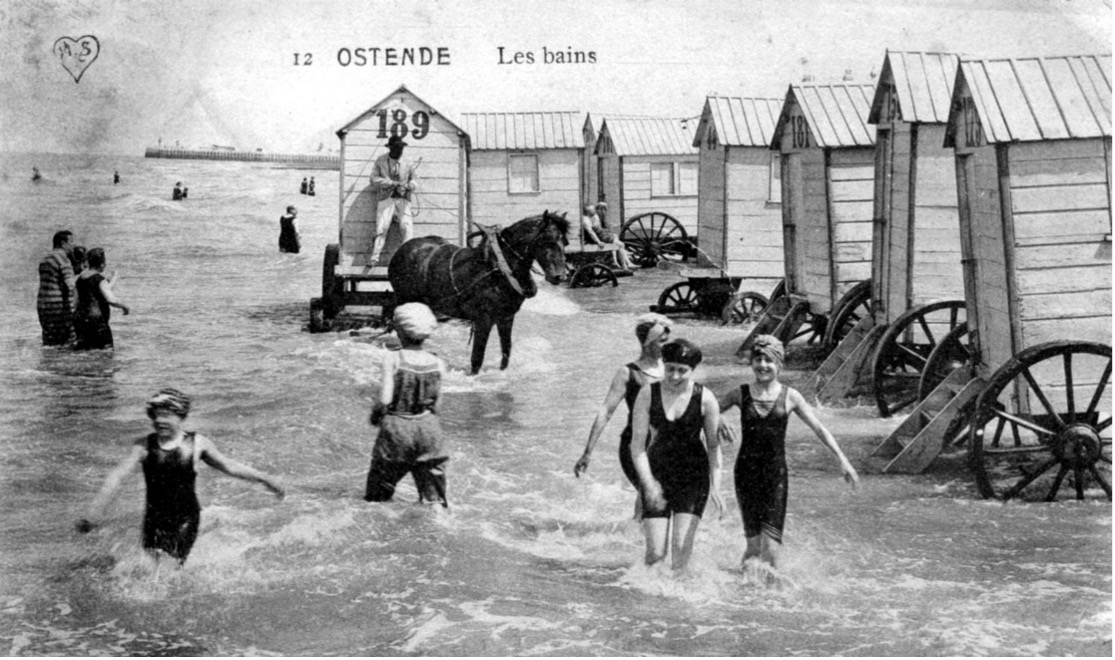
Mensen zoeken verfrissing in het water, Oostende, 1911. (© Postkaart van IBA, publiek domein)
People seek refreshment in the water, Ostend, 1911.

(© Postcard from IBA, public domain)

In the course of August, it became clear that the heat was taking its toll mainly on the youngest. This was first apparent from figures from Paris and then from London, and on 24 August Het Handelsblad reported that this was also the case in Antwerp. The newspaper linked the high child mortality to the quality of milk. The heat and drought, and the resulting lack of animal feed, had made milk scarce and expensive.

Research by the demographer Godelieve Stroobant confirms that the heat of 1911 took a heavy toll, and that young children were the main victims. She estimates that in 1911 there were about 9,000 more deaths in Belgium than expected and the majority of them, more than 6,000, were young children. Many of them died with symptoms of stomach flu (gastroenteritis), partly due to the lack of milk and water caused by the heat and drought. Her sources also reported that during the summer of 1911, a large number of children died of gastroenteritis in and around Antwerp. 

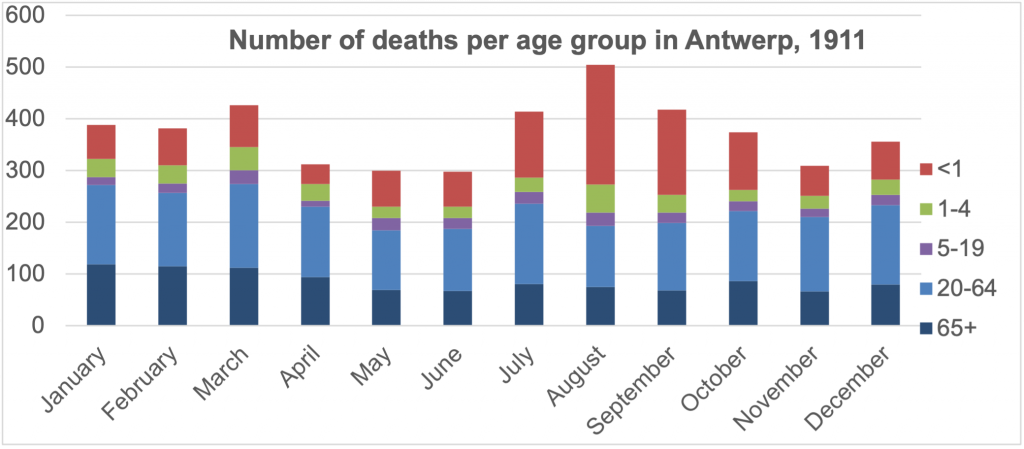
Figures from S.O.S. Antwerp support this claim. From January to June 1911, an average of 65 babies (younger than 1 year) died every month in Antwerp. During the summer months that number rose sharply, to 232 in August (graph 4.). In more than half the cases in August, intestinal complaints were noted as the cause of death, in particular stomach and intestinal inflammation or gastroenteritis. Thanks to the Antwerp data, researchers can now examine in detail to what extent the mortality during the summer of 1911 differs from that of other summers.

Graph 4.

Nevertheless, Stroobant found that rural areas were most vulnerable during that summer. Mortality was highest in the province of Limburg, where the highest temperatures were also recorded. Indeed, the drought caused the most problems in rural municipalities. At that time, large cities such as Antwerp already had water pipes. However, the quality of the mains water in Antwerp also suffered during the drought, and the local government advised residents not to use it without first boiling it.

Different victims during historical and contemporary heatwaves?

The heat of 1911 caused exceptionally high casualties. Little is currently known about other historical heat waves, but the Antwerp data may change that. Thanks to the work of the many volunteers, we can now find out not only who was vulnerable during heat waves, but also what people died of. If this shows that, as in 1911, young children were the most vulnerable, due to the combination of gastroenteritis and heat, then historical and contemporary heat waves resulted in very different victims. Indeed, today it is not young children but the elderly who are most at risk from heat. It is possible that many elderly people were also victims of heat waves in the past, but their share in the population was too small to have a major impact on the overall mortality rate. 

It is anticipated that peaks in heat-related mortality will become even more frequent in the future, due to ageing, urbanisation and global warming. The latter is the main difference between historical and contemporary heat waves. Even though historical heat waves caused many causalities, the heat waves themselves were a relatively rare phenomenon. The experience of the past few summers shows us that this is no longer the case.


Sources

  • “Bescherming der policie” [“Protection of the police”], Gazet van Antwerpen, 11 August 1911, p. 2
  • “Brussel – Slachtoffers van de Hitte”[“Brussels – Victims of the Heat”], Gazet van Antwerpen, 24 July 1911, p. 4. 
  • “Dagelijkse temperaturen te Ukkel sinds 1833” [“Daily temperatures at Ukkel since 1833”], Ransberg Weather Station website (https://www.weerstationransberg.be/Dagelijksetemperaturensinds1833.xlsx)
  • “De Branden” [“The Fires”], Gazet van Antwerpen, 14/15 August 1911, p. 1. 
  • “De duurte der boter” [“The high cost of butter”] , Handelsblad, 26 August 1911, p. 2. 
  • “De eetwarencrisis” [“The food crisis”], Handelsblad, 11 September 1911, p. 1. 
  • “De Hitte” [“The Heat”], Handelsblad, 2 August 1911, p. 2. 
  • “De Hitte” [“The Heat”], Handelsblad, 24 July 1911, p. 3.
  • “De Hitte” [“The Heat”], Handelsblad, 25 July 1911, p. 2. 
  • “De Sterfte te Londen” [“Mortality in London”], Handelsblad, 24 August 1911, p. 2. 
  • “Gevolgen der aanhoudende droogte” [“Effects of the prolonged drought”], Handelsblad, 24 August 1911, p. 4. 
  • “Grote brand aan de dokken” [“Huge fire at the docks”], Handelsblad, 11 August 1911, p. 1.
  • “Hitte en onweer” [“Heat and thunderstorms”], Handelsblad, 31 July 1911, p. 2. 
  • “Slachtoffers van de Hitte” [“Victims of the Heat”], Gazet van Antwerpen, 31 July 1911, p. 4. 
  • De Smet D., “Beperkte sterfte door hittegolf” [Limited mortality due to heat wave”], De Standaard, 12 September 2022, p. 9.
  • UGent, Quetelet Center, S.O.S. Antwerp Database

Literature

  • Brücker, G. (2005), “Vulnerable populations: lessons learnt from the summer 2003 heat waves in Europe”, Eurosurveillance 10, no. (7) (2005): 1-2.
  • Deboosere, F., “Wat is een hittegolf?” [“What is a heat wave”], https://www.frankdeboosere.be/vragen/vraag227.php (consulted on 19.09.2022).
  • García-Herrera, R., J. Díaz, et al. (2010), “A Review of the European Summer Heat Wave of 2003”, Critical Reviews in Environmental Science and Technology 40, no. (4) (2010): 267-306.
  • Kosatsky, T. (2005), “The 2003 European heat waves”, Eurosurveillance 10, no. (7) (2005): 3-4.
  • Masuy-Stroobant, G. (2010), “1911: un été exceptionnel en Belgique?” [“1911: an exceptional summer in Belgium”], Annales de démographie historique, no. (120) (2010): 179-197.
  • United Nations Regional Information Centre, “Klimaat: worden hittegolven ‘nieuwe normaal’?)” [“Climate: are heat waves becoming the ‘new normal’?”], https://unric.org/nl/klimaat-worden-hittegolven-nieuwe-normaal/ (consulted on 19.09.2022).
  • Robine, J.-M., S. L. K. Cheung, et al. (2008), “Death toll exceeded 70,000 in Europe during the summer of 2003”, Comptes Rendus Biologies 331, no. (2) (2008): 171-178.
  • Sardon, J.-P. (2007), “The 2003 heat wave”, Eurosurveillance 12, no. (3) (2007): 11-12.
  • Sartor, F. (2004), La surmortalité en Belgique au cours de l’été 2003 [Excess mortality in Belgium during the summer of 2003]. IPH/EPI Reports no. 2004 – 009. Brussels, Institut Scientifique de Santé Publique, 2004.
  • Vlaamse Milieumaatschappij, “Slachtoffers bij hittegolven” [“Victims of heat waves”], https://www.vlaanderen.be/DataCatalogRecord/bcc21e33-5a2e-30ba-8ad8-872c2fa3660d (consulted on 19.09.2022).

The S.O.S. Antwerp dataset is under construction and is scheduled to be put into use in the course of 2023. Anyone wishing to use the data infrastructure can contact a Quetelet Centre staff member at queteletcenter@ugent.be

The database came about through a citizen science project. You can follow the progress of the project at www.sosantwerpen.be

Feel like lending a hand? Then send a message to sosantwerpen@ugent.be.