Organisch stedelijk afval als meststof in de landbouw?

DETAILS

Gebruikte databank:

LOKSTAT & POPPKAD

Datum:

2017

Categorie:

Wetenschappelijke publicatie

ORGANISCH STEDELIJK AFVAL ALS MESTSTOF IN DE LANDBOUW?

Pieter De Graef plaatst in zijn artikel vraagtekens bij de historische voorbeelden van gesloten cradle-to-cradle systemen, die door ecologische historici naar voor worden geschoven als voorlopers van huidige gesloten voedingscycli. Hij deed een beroep op landbouwtellingen en kadastrale statistieken uit LOKSTAT en POPPKAD om te berekenen hoeveel meststof werd geproduceerd in verschillende regio’s. 

Artikel:

De Graef, Pieter. “Food from country to city, waste from city to country: an environmental symbiosis? Fertiliser improvement in eighteenth-century Flanders”. Journal for the History of Environment and Society 2 (2017): 25–61.

Abstract:

“Alternative approaches to resolve bottlenecks in food production often champion the reuse of urban organic waste as fertiliser in agriculture in order to close the nutrient cycle between city and country (cradle to cradle). References are often made to the past because environmental historians tend to work the use of urban wastes into a story of environmental symbiosis between city and countryside. This article argues, however, that closed nutrient cycles did not exist even in pre-industrial society, as the way in which agriculture was structured had a huge impact on the demand for manure. Starting from two agricultural regions in eighteenth-century Flanders, this research calls for more attention to regional structures of agriculture in which cities were embedded and to how these agro-systems shaped nutrient flows from the city to the country by very diverse patterns of demand for fertilisers, leading to unequal redistributive flows of nutrients from towns to different agricultural regions.”
De kuddes uitgedund

DETAILS

Gebruikte databank:

POPPKAD

Datum:

november 2018

Categorie:

Wetenschappelijke Publicatie

DE KUDDES UITGEDUND

In hun artikel getiteld “Culling the herds” vergeleken Adam Sundberg en Filip Van Roosbroeck de  overheidsmaatregelen in de Oostenrijkse en Noordelijke Nederlanden tegenover de runderpest van 1769-1785. De onderzoekers berekenden de sterfte onder het vee in beide regio’s en baseerden zich hiervoor onder meer op statistieken over landgebruik uit POPPKAD. Volgens de auteurs speelden de verschillende socio-ecologische structuren en de uiteenlopende praktijken in de commerciële landbouw een meer belangrijke rol in de verspreiding van de ziekte dan het beleid dat de verschillende overheden voerden. 

Artikel: 

Van Roosbroeck, Filip, en Adam Sundberg. “Culling the herds? Regional divergences in rinderpest mortality in Flanders and South Holland, 1769-1785”. TSEG/ Low Countries Journal of Social and Economic History 14, nr. 3 (2018): 31–55. 

Abstract:

“The cattle disease rinderpest devastated Europe throughout the eighteenth century. The practice of preventative slaughter, or stamping out, has been seen as the most effective method of containing the disease. Historians frame this strategy as a measure of the effectiveness of centralized bureaucracy in handling epidemic outbreaks. The Austrian Netherlands, which enacted a stamping out policy during the rinderpest epidemic of 1769-1785, is often cast opposite the decentralized Dutch Republic, which did not. That mortality was more severe in Holland than in Flanders is interpreted as a consequence of this difference. This article compares the disease management of Flanders and South Holland as well as the differential mortality of cattle in the initial years of the outbreak. We argue that stamping out should not be used as the standard for evaluating effective management. Both South Holland and Flanders relied on a high degree of state intervention. No strategies were universally effective. Explanations must be sought in regional socio-ecological structures. Rather than a consequence of state action or inaction, rinderpest mortality responded to the movement of cattle for pasturing and trade, structural differences in land use, and the resultant divergences in agricultural practices and herd management. Rather than state intervention, extensive commercial cattleholding explains the highly variable mortality.”

LOKSTAT-data toegepast op lokaal niveau

DETAILS

Gebruikte databank:

LOKSTAT

Datum:

juli 2018

Categorie:

Publicatie

LOKSTAT-DATA TOEGEPAST OP LOKAAL NIVEAU

Aan de hand van de landbouwtelling van 1895 en de nijverheidstelling van 1896 schreef Pieter Neirinckx twee artikelen over de economische ontwikkeling in Genk. Deze publicaties zijn slechts één voorbeeld van wat lokale historici en heemkundigen kunnen verwezenlijken met het rijke aanbod aan data die het Queteletcentrum online ter beschikking stelt. 

Maak zelf kaarten op basis van de nijverheidstelling van 1896, bekijk gegevenstabellen van de landbouwtelling van 1895 of van de volkstelling van 1900 . Het Queteletcentrum beheert ook andere reeksen uit de LOKSTAT-databank die ter beschikking van onderzoekers staan. 

Artikels: 

Neirinckx, Pieter. “De landbouw in Genk aan het einde van de 19de eeuw”. Tweemaandelijks tijdschrift van de Heemkring Heidebloemke Genk 77, nr. 2 (2018): 34–36. 

Neirinckx, Pieter. “De Genkse industrie aan het einde van de 19de eeuw”. Tweemaandelijks tijdschrift van de Heemkring Heidebloemke Genk 76, nr. 2. (2017): 20-22.

Maakten de pokken je klein?

DETAILS

Gebruikte databank:

LOKSTAT & STREAM

Datum:

augustus 2018

Categorie:

Wetenschappelijke publicatie

MAAKTEN DE POKKEN JE KLEIN?

Met behulp van de uitkomsten van de 19de-eeuwse volkstellingen voor Tielt uit de LOKSTAT-databank en de socio-professionele verdeling voor de 18de eeuw uit de STREAM-databank tonen Vervaeke en Devos in deze studie aan dat het effect van deze ziekte op de lengte , in tegenstelling tot de familiale omstandigheden, niet statistisch relevant is.

Artikel

Vervaeke, Ans, en Isabelle Devos. “Much ado about nothing? Reconsidering the smallpox effect. Height in the nineteenth-century town of Thielt, Belgium”. TSEG/ Low Countries Journal of Social and Economic History 14, nr. 4 (2018): 56-83.

Abstract:

“Anthropometric evidence such as height has been considered a major indicator of the social and economic well-being of past societies. To understand differences in attained height, the role of several determinants has been widely discussed. Since the 1990s, the impact of disease has shown to be a promising topic. In particular, research on the effect of smallpox on the height of the population in nineteenth-century England has triggered heated debate. Voth and Leunig argue that smallpox stunted height, but their results have been called into serious question by scholars such as Oxley, Razzell, Heintel and Baten. In this article, we introduce new sources and evidence for Thielt, a small rural town in Belgium. By linking military registers with smallpox listings, our analysis allows for a nuanced study of the height of conscripts. In early nineteenth-century Thielt, height differences between smallpox survivors and those who did not fall prey to the disease appear to be largely the result of household circumstances. By taking into account individual and familial attributes, we show the importance of the father’s death and father’s occupation for the son’s height. However, smallpox did not have a statistically significant effect on height.”

Een groene revolutie in de 18de eeuw?

DETAILS

Gebruikte databank:

POPPKAD

Datum:

oktober 2018

Categorie:

Publicatie

EEN GROENE REVOLUTIE IN DE 18DE EEUW?

Lees het volledige artikel of consulteer de POPPKAD-website.

Artikel:

De Graef, Pieter. “A Green Revolution from below? A social approach to fertiliser use in eighteenth-century Flanders”. Continuity and Change 32, nr. 3 (2017): 379–410.

Abstract:

“Profound changes in output and productivity characterised eighteenth-century agriculture, both in regions of large-scale capitalist farming and smallholding cultivation. Aggregate, macro-level studies offer valuable insights, but often prove unable to explain yield increases. Therefore, this article proposes a social approach to agricultural production through a micro-level analysis of fertilisation strategies, taking the smallholding economy of inland Flanders as a starting point. The household perspective demonstrates that a green ‘fertiliser’ revolution with increasing levels of fertilising intensity and off-farm nutrient inputs was instigated from below on both small and large holdings as a response to the broader economic and societal situation.”

Onderzoekers van de Université catholique de Louvain maken gebruik van de LOKSTAT-databank

DETAILS

Gebruikte databank:

LOKSTAT

Datum:

november 2018

Categorie:

Publicatie

ONDERZOEKERS VAN DE UNIVERSITE CATHOLIQUE DE LOUVAIN MAKEN GEBRUIK VAN DE LOKSTAT-DATABANK

Annalisa Frigo en Eric Roca onderzochten het effect van de aanwezigheid van begijnen in bepaalde Belgische gemeenten op hedendaagse genderverhoudingen. Lees hun bevindingen in de paper of ga zelf aan de slag met de gegevens uit de LOKSTAT-databank.

Artikel:

Frigo, Annalisa, en Eric Roca. “Roots of gender equality: the persistent effect of beguinages on attitudes toward women”. Labour Seminar Paper, Milan Bocconi University, 2018.

Abstract: 

“This paper is concerned with the historical determinants of gender equality. In the specific context of Belgium, it relates higher levels of gender equality during the 19th century to the presence of medieval, female-only, Belgian communities called beguinages. Combining a novel, hand-collected data-set on beguinage location with 19th-century Belgian census data, we document that in municipalities where beguine communities settled the literacy gap reduced. Schooling was not compulsory and literacy differentials reflect parental tenets on gender equality. Using changes in the political organisation through which some villages became more attractive to beguines, we establish that the variation in gender literacy is indeed related to the presence of beguinages. Our results are in line with the extensive empirical evidence documenting the persistence of gender norms and culture. Finally, we propose a novel class of mechanisms, based on improvements in girls’ bargaining power, to rationalise our findings”

Neurowetenschappers aan de slag met LOKSTAT-data

DETAILS

Gebruikte databank:

LOKSTAT

Datum:

2018

Categorie:

Publicatie

NEUROWETENSCHAPPERS AAN DE SLAG MET LOKSTAT-DATA

De bevindingen van het onderzoek van Aleida Frissen, Jim Van Os, Sanne Peeters, Ed Gronenschild en Machteld Marcelis werden onlangs gepubliceerd in het tijdschrift “Psychiatry Research. Neuroimaging”. De wetenschappers tonen aan dat minder grijze hersenstof bij psychotische stoornissen het resultaat kan zijn van een verhoogde gevoeligheid voor omgevingsrisco’s, en dit vooral bij mannelijke patiënten. Lees dit opmerkelijke onderzoek zelf na. 

Artikel:

Frissen, Aleida, Jim van Os, Sanne Peeters, Ed Gronenschild, Machteld Marcelis, en for Genetic Risk and Outcome in Psychosis (G.R.O.U.P.). “Evidence that reduced gray matter volume in psychotic disorder is associated with exposure to environmental risk factors”. Psychiatry Research. Neuroimaging 271 (2018): 100–110.

Abstract:

“The aim of this study was to examine whether cannabis use, childhood trauma and urban upbringing are associated with total gray matter volume (GMV) in individuals with (risk for) psychotic disorder and whether this is sex-specific. T1-weighted MRI scans were acquired from 89 patients with a psychotic disorder, 95 healthy siblings of patients with psychotic disorder and 87 controls. Multilevel random regression analyses were used to examine main effects and interactions between group, sex and environmental factors in models of GMV. The three-way interaction between group, sex and cannabis (χ2 =12.43, p<0.01), as well as developmental urbanicity (χ2 = 6.29, p = 0.01) were significant, indicating that cannabis use and developmental urbanicity were associated with lower GMV in the male patient group (cannabis: B= -32.54, p < 0.01; developmental urbanicity: B= -10.23, p=0.03). For childhood trauma, the two-way interaction with group was significant (χ2 = 5.74, p = 0.02), indicating that childhood trauma was associated with reduced GMV in the patient group (B=-9.79, p=0.01). The findings suggest that reduction of GMV in psychotic disorder may be the outcome of differential sensitivity to environmental risks, particularly in male patients.”

De vele gezichten van armenzorg

DETAILS

Gebruikte databank:

STREAM

Datum:

januari 2018

Categorie:

Publicatie

DE VELE GEZICHTEN VAN ARMENZORG

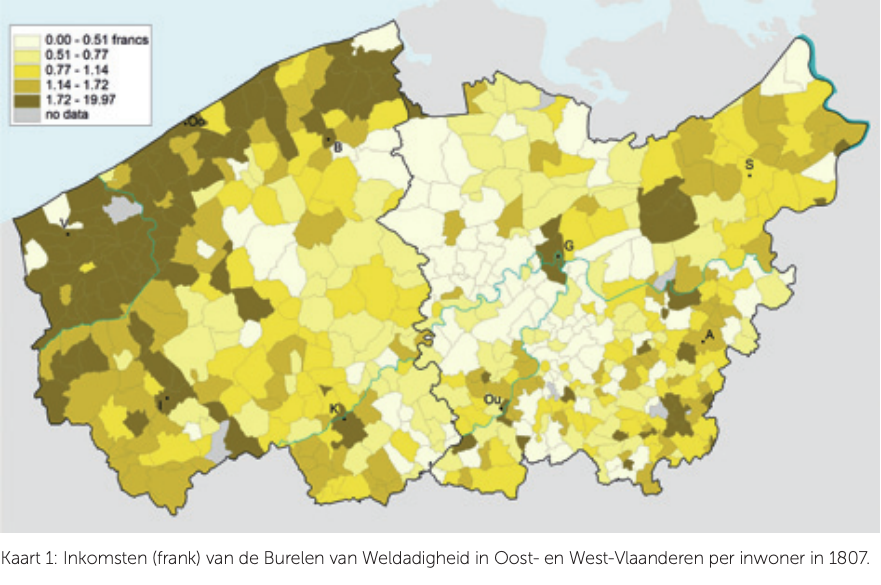
Thijs Lambrecht en Anne Winter tonen in hun artikel in “Tijd-Schrift: Heemkunde en Lokaal-erfgoedpraktijk in Vlaanderen” aan hoe de armenzorg op het platteland in het graafschap Vlaanderen tijdens de 18de eeuw was georganiseerd. Op basis van gegevens uit de STREAM-databank konden ze afleiden dat bijna alle gemeenten in het voormalig graafschap over inkomsten voor armenzorg beschikten. Deze inkomsten haalden de gemeenten onder meer uit huurinkomsten van onroerende bezittingen, renten uit kapitaal en belastingen. Er bestond weliswaar een grote ruimtelijke variatie. De medewerkers van het Queteletcentrum stelden deze gegevens op kaart voor (zie afbeelding).

Artikel: 

Lambrecht, Thijs, en Anne Winter. “De vele gezichten van zorg: armoede en armenzorg op het platteland in het graafschap Vlaanderen tijdens de achttiende eeuw”. Tijd-Schrift: Heemkunde en Lokaal-erfgoedpraktijk in Vlaanderen 7, nr. 1 (2017): 44–57.

Een stuk grond voor iedereen?

DETAILS

Gebruikte databank:

LOKSTAT en POPPKAD

Datum:

2017

Categorie:

Conferentiebijdrage

EEN STUK GROND VOOR IEDEREEN?

Artikel: 

Ronsijn, Wouter. “‘Gaining ground’ in Flanders after the 1840s: access to land and coping mechanisms of (semi-)landless households in Flanders, ca. 1850-1900”, Rural History Conference, 1–35. Leuven, 2017.


Abstract: 

“This paper explores whether, as a result of this shifting power balance, rural households in Flanders in the second half of the nineteenth century were literally gaining ground. All scholars see this period as a profound turning point for the Flemish countryside, affecting both rural coping mechanisms and agricultural production methods. […] Up until then, livelihoods in Flanders often combined small-scale farming for one’s own account with wage labour or market-oriented production, although there were regional variations to that pattern. This paper focuses on what happened with access to land, the indispensable condition for the first component. Did access to land increase, as would be consistent with the change of fortunes mentioned above, or did it decrease, as would be consistent with the overall, long-term European trend of rising landlessness? […] The paper reconstructs the extent of landlessness (households without land) and semi-landlessness (households with less than 2 ha of land, the minimum required for subsistence; this includes households without land) in Flanders, and to indicate the factors affecting that extent in the second half of the nineteenth century. It asks how many landless and semi-landless households there were in Flanders, and how access to land fit in with their other activities? The paper focuses on developments in four regions showing divergent patterns: the districts of Veurne, Kortrijk, Sint-Niklaas and Oudenaarde.”

Hoe je levensstijl als tiener meer implicaties heeft dan je denkt…

DETAILS

Gebruikte databank:

LOKSTAT

Datum:

2017

Categorie:

Wetenschappelijke publicatie

HOE JE LEVENSSTIJL ALS TIENER MEER IMPLICATIES HEEFT DAN JE DENKT

Artikel: 

Depauw, Ewout, en Deborah Oxley. “Toddlers, teenagers and terminal heights: the determinants of adult male stature, Flanders, 1800-76”. Onder redactie van Rui Esteves en Gabriel Geisler Mesevage. Discussion Papers in Economic and Social History 157 (2017): 1–34.


Abstract: 

“Does adult stature capture conditions at birth or at some other stage in the growth cycle? Anthropometrics is lauded as a method for capturing net nutritional status over all the growing years. However, it is frequently assumed that conditions at birth were most influential. Was this true for historical populations? This paper examines the heights of Belgian men born between 1800-76 to tease apart which moments of growth were most sensitive to disruption and reflected in final heights. It exploits two proximate crises in 1846-49 and 1853-56 as shocks that permit age effects to be revealed. These are affirmed through a study of food prices and death rates. Both approaches suggest a shift of the critical moment away from the first few years of life and towards the adolescent growth spurt as the most influential on terminal stature. Furthermore, just as height is accumulated over the growing years, conditions influencing growth need to be understood cumulatively. Economic conditions at the time of birth were not explanatory, but their collective effects from ages 11 to 18 years were strongly influential. Then, both health and nutrition mattered, in shifting degrees. Teenagers, not toddlers, should be our guides to the past.”

Het Queteletcentrum levert basiskaarten over België aan de Linked Open dataset World War I

DETAILS

Gebruikte databank:

LOKSTAT

Datum:

november 2017

Categorie:

Wetenschappelijke publicatie

HET QUETELETCENTRUM LEVERT BASISKAARTEN OVER BELGIË AAN DE LINKED OPEN DATASET WORLD WAR I

Article: 

Mäkelä, Eetu, Juha Törnroos, Thea Lindquist, en Eero Hyvönen. “WW1LOD: an application of CIDOC-CRM to World War 1 linked data”. International Journal on Digital Libraries 18, nr. 4 (November 2017): 333–43.


Abstract: 

“The CIDOC-CRM standard indicates that common events, actors, places and timeframes are important in linking together cultural material, and provides a framework for describing them. However, merely describing entities in this way in two datasets does not yet interlink them. To do that, the identities of instances still need to be either reconciled, or be based on a shared vocabulary. The WW1LOD dataset presented in this paper was created to facilitate both of these approaches for collections dealing with the First World War. For this purpose, the dataset includes events, places, agents, times, keywords, and themes related to the war, based on over ten different authoritative data sources from providers such as the Imperial War Museum. The content is harmonized into RDF, and published as a Linked Open Data service. While generally based on CIDOC-CRM, some modeling choices used also deviate from it where our experience dictated such. In the article, these deviations are discussed in the hope that they may serve as examples where CIDOC-CRM itself may warrant further examination. As a demonstration of use, the dataset and online service have been used to create a contextual reader application that is able to link together and pull in information related to WW1 from, e.g., 1914–1918 Online, Wikipedia, WW1 Discovery, Europeana and the Digital Public Library of America.”

Onderzoekers over het vergunningenbeleid in Vlaanderen doen een beroep op LOKSTAT

DETAILS

Gebruikte databank:

LOKSTAT

Datum:

November 2017

Categorie:

Publicatie

ONDERZOEKERS OVER HET VERGUNNINGENBELEID IN VLAANDEREN DOEN EEN BEROEP OP LOKSTAT

In de nota ‘Vergunningenbeleid in Vlaanderen’, die deel uitmaakt van een vierdelig rapport opgesteld in opdracht van de Vlaamse overheid, werd de vergunningendatabank voor heel Vlaanderen voor de periode 1962-2016 geanalyseerd. De databank bevat meer dan 3,5 miljoen stedenbouwkundige vergunningsaanvragen. De LOKSTAT-data werd gebruikt om een inschatting te maken van de bevolkingsgroei, die een rechtstreeks effect heeft op het aantal vergunningsaanvragen. De LOKSTAT-dataset over de gemeentelijke bevolkingsomvang is een unieke historische bron die zeer uiteenlopende kwantitatieve analyses mogelijk maakt.

Nota: 

Vanoutrive, Thomas, en Jeroen Cant. Vergunningenbeleid in Vlaanderen: kwantitatieve analyse van de vergunningendatabank. Brussel: Vlaams planbureau voor Omgeving, 2017.

Waarom boeren groter waren dan wevers

DETAILS

Gebruikte databank:

LOKSTAT

Datum:

december 2017

Categorie:

Wetenschappelijke publicatie

WAAROM BOEREN GROTER WAREN DAN WEVERS?

Ewout Depauw maakte voor zijn onderzoek over de levensstandaard in het rurale  Vlaanderen tijdens de 19de eeuw gebruik van gemeentelijke bevolkingscijfers en andere gegevens uit de LOKSTAT-databank. Met behulp van de cartografische module HISGIS, die deel uitmaakt van de onderzoeksinfrastructuur, konden de gegevens bovendien ruimtelijk worden geanalyseerd. Ontdek de resultaten van zijn onderzoek in het artikel. 

Artikel

Depauw, Ewout. “Tall Farmers and Tiny Weavers. Rural Living Standards and Heights in Flanders, 1830-1870”, TSEG/ Low Countries Journal of Social and Economic History 14, nr. 3 (2018): 56–84.   

Abstract: 

“The evolution of the average stature of convicts between 1830 and 1870 in the prisons of Ghent and Bruges is used as a measure of the biological standard of living and suggests progress in the quality of life in the Flemish countryside, particularly for children born after 1850. Heights are used to shed light on regional variations. Prisoners born in coastal Flanders were on average shorter than inmates born in inland Flanders. Heights furthermore provide a key to discovering specific socio-economic differences that can explain such variations, showing that wage labourers in coastal Flanders and textile workers in inland Flanders were the shortest occupational groups, especially before 1850. As such, heights provide a nuanced picture of living standards in rural Flanders during the nineteenth century.” 

Steekproefselectie brengt orde in de chaos

DETAILS

Gebruikte databank:

BETHUNE

Datum:

oktober 2017

Categorie:

Wetenschappelijke publicatie

STEEKPROEFSELECTIE BRENGT ORDE IN DE CHAOS

In de BETHUNE-databank vind je de verkoopfacturen van het textielbedrijf “Bethune et fils” terug. De databank kwam tot stand in het kader van het doctoraat van Annik Adriaenssens “Van laken tot linnen. De textielhandel Bethune & Fils. Tweede helft achttiende eeuw. Een analyse op basis van het  bedrijfsarchief”. Coessens en Heirman gingen voor hun onderzoek  aan de slag met de verkoopfacturen opgemaakt tussen 1737 en 1799 die in de databank werden opgenomen.

Lees het volledige hoofdstuk: 

Coessens, Ine, en Wim Heirman. “Statistische steekproefmethodes. Een handleiding tot statistisch verantwoorde selectie” . In Handboek Archiefbeheer in de praktijk. Vol. 102. 2017.

Geografische verschillen in doodsoorzaken

DETAILS

Gebruikte databank:

HISSTER

Datum:

mei 2018

Categorie:

Wetenschappelijke publicatie

GEOGRAFISCHE VERSCHILLEN IN DOODSOORZAKEN

Voor hun artikel “Spatial disparities at death. Age-, sex- and disease-specific mortality in the districts of Belgium at the beginning of the twentieth century” maakten Tina Van Rossem, Patrick Deboosere en Isabelle Devos gebruik van de HISSTER-databank. Ze reconstrueerden de leeftijds-, geslachts- en ziektespecifieke sterftecijfers voor de 41 Belgische arrondissementen in het jaar 1910. Op basis van de gegevens verzameld in HISSTER creëerden ze kaarten die de regionale variaties blootleggen. Lees het volledige artikel hier

Raadpleeg de HISSTER-databank om zelf met de gegevens aan de slag te gaan:

Artikel: 

Van Rossem, Tina, Patrick Deboosere, en Isabelle Devos. “Spatial disparities at death. Age-, sex- and disease-specific mortality in the districts of Belgium at the beginning of the twentieth century”. Espace Populations Sociétés. Space Populations Societies, nr. 1-2 (2018): 1-22. 


Wat was er mis met de West-Vlamingen?

DETAILS

Gebruikte databank:

LOKSTAT, HISSTER

Datum:

13 maart 2018

Categorie:

Publicatie

WAT WAS ER MIS MET DE WEST-VLAMINGEN?

In het artikel “Grasduinen in de bevolkingsgeschiedenis: wat was er mis met de West-Vlamingen?” bespreekt Kristof Clerix de Mouvement, een gigantische bron voor 19de-eeuwse bevolkingsinformatie, die deels ontsloten werd via de LOKSTAT- en HISSTER-gegevensbanken van het Queteletcentrum. De Mouvement de la Population et de l’Etat Civil of kortweg Mouvement bestaat uit een omvangrijke reeks van registers vol tabellen met massa’s cijfergegevens  over de Belgische bevolking in de periode 1841-1976. De registers bevatten gedetailleerde cijfers tot op het niveau van de gemeenten over geboorten, huwelijken, overlijdens, doodsoorzaken, enzovoort. 

Kristof Clerix gaat in gesprek met Isabelle Devos, Queteletcoördinator, die dankzij de gedeeltelijke integratie van de gegevens uit de Mouvement in de LOKSTAT- en HISSTER-gegevensbanken tot opmerkelijke inzichten kwam. Door de informatie uit de Mouvement te koppelen aan het historisch geografisch informatiesysteem ontwikkeld door medewerkers van het Queteletcentrum en die op kaart weer te geven, werd het mogelijk om  regionale verschillen bloot te leggen en nieuwe hypotheses naar voor te schuiven om bijvoorbeeld sterftecijfers te duiden.

Wilt u ook weten waarom er precies zoveel sterfte was in de Westhoek? Lees dan zeker het volledige Knack-artikel van Kristof Clerix of bekijk de wetenschappelijke publicatie hieromtrent van Isabelle Devos. 

Raadpleeg de LOKSTAT- of HISSTER-databankpagina om zelf met de gegevens aan de slag te gaan.

Adolphe Quetelet, een bruggenbouwer

DETAILS

Gebruikte databank:

/

Datum:

februari 2018

Categorie:

Adolphe Quetelet

ADOLPHE QUETELET, EEN BRUGGENBOUWER

Als grondlegger van de statistiek speelde Adolphe Quetelet (1796-1874) een voortrekkersrol in de evolutie van de overheidsinstellingen en het wetenschappelijk onderzoek in het 19de-eeuwse België. Schamper journaliste Selin Bakistanli interviewde Isabelle Devos, professor geschiedenis aan de vakgroep Geschiedenis van de Universiteit Gent en coördinator van het Queteletcentrum, over het belang van deze man voor de ontwikkeling van de statistische dataverzameling en -interpretatie.

Lees hier het volledige artikel. 


Grootse plannen

DETAILS

Gebruikte databank:

POPPKAD

Datum:

januari 2018

Categorie:

Publicatie

GROOTSE PLANNEN

De atlas van Popp is een gecommercialiseerde versie van het kadaster waarin uiteenlopende inlichtingen over vastgoed uit grote delen van het land zijn samengebracht. Op ruim 41 000 bladzijden en meer dan 2 300 kaartbladen worden alle gebouwen, percelen en eigenaars afzonderlijk beschreven. De uitgave is uniek in zijn soort. Er bestaan geen publicaties die zich qua omvang, rijkdom aan informatie en graad van detail aan Popps werk kunnen meten.

Vandaag maken onderzoekers dankbaar gebruik van dit unieke naslagwerk. Wie harde informatie zoekt over personen, gebouwen, landschappen, huisvesting, landbouw, nijverheid, ruimtelijke inrichting of plaatselijke geschiedenis in de 19de-eeuw, komt in deze uitgave aan zijn of haar trekken. 

Hoewel de atlas reeds lang bekendheid geniet onder historici en geografen, blijft de publicatie nog grotendeels in duisternis gehuld. Het is gissen naar de motieven van de makers. Evenmin is geweten waarom soortgelijke naslagwerken in België en de omringende landen ontbreken.

“Grootse plannen” bevat naast de ontstaansgeschiedenis ook een gedetailleerde beschrijving van de atlas zelf. Alle 1 735 verschenen afleveringen worden in het boek stuk voor stuk beschreven en (vaak voor het eerst) gedateerd. Verder bevat “Grootse plannen” een methodologische toelichting over huizenonderzoek met behulp van Popps atlas.

Ook de gegevensbank POPPKAD, die door het Queteletcentrum wordt beheerd, ontsluit het omvangrijke naslagwerk van P.C. POPP. 

Wil je zelf graag met deze gegevens aan het werk? Consulteer dan zeker de POPPKAD-pagina

Sven Vrielinck
Een uitgave van

Amsterdam University Press
Hardback,
164 pagina’s,
ISBN 978 94 6298 785 2
Prijs: 29,99 €

Bestellen:

Was opa een nazi?

DETAILS

Gebruikte databank:

LOKSTAT

Datum:

2017

Categorie:

Boek

WAS OPA EEN NAZI?

Boek: 

Aerts, Koen, Dirk Luyten, Paul Drossens, en Pieter Lagrou. Was opa een nazi? Speuren naar het oorlogsverleden van je familie. Tielt: Lannoo N.V, 2017.

Korte inhoud boek:

“Zo’n half miljoen Belgen – Vlamingen, Brusselaars en Walen – hebben een familielid dat ‘fout’ was tijdens de Tweede Wereldoorlog. Opa, oma, vader, moeder, oom of tante. Aanvankelijk zijn er ruim 400.000 dossiers van verdachten. Zo’n 100.000 burgers krijgen ook effectief een straf: van terechtstelling over vrijheidsberoving tot verlies van rechten. Kleinkinderen en andere familieleden gaan vandaag meer en meer op zoek naar de juiste toedracht van de feiten om dat verleden een plaats te geven. In Was opa een nazi? reiken oorlogshistorici en archivarissen de sleutels aan om zelf op zoek te gaan naar het vaak onuitgesproken oorlogsverleden.”